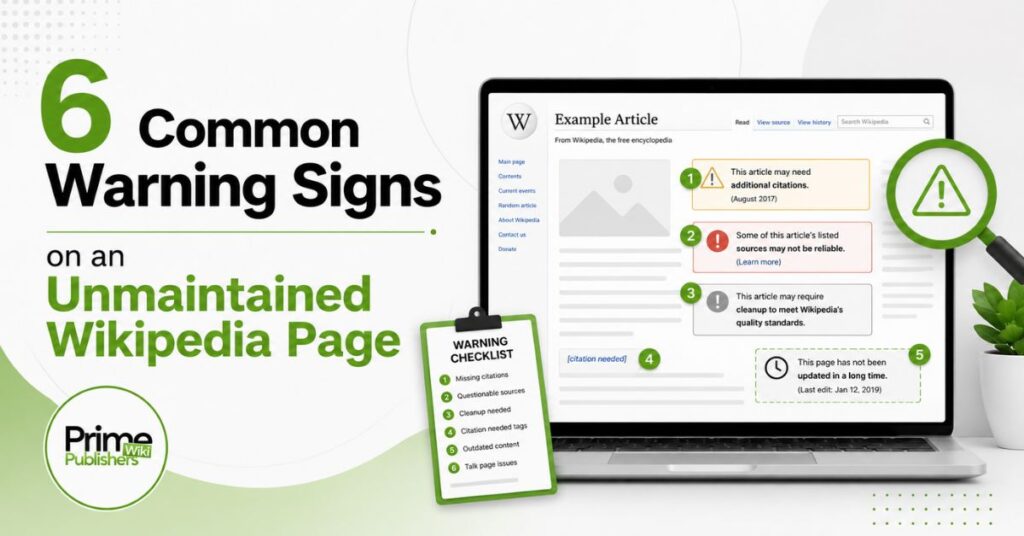
A Wikipedia page is not a fixed company profile or personal website. It is a public encyclopedia article that can be reviewed, corrected, expanded, challenged, or edited by volunteer contributors at any time. Because of this open system, even a well-written page can slowly develop problems when nobody checks its condition.
New information may be left out, citations can stop working, unclear edits may remain unnoticed, and maintenance notices may appear. These issues do not always mean that a page is in immediate danger. However, they are warning signs that the article may need careful review.
Regular Wikipedia page monitoring helps identify changes early. It should focus on accuracy, neutrality, reliable sourcing, and Wikipedia’s rules, not on controlling the article or turning it into advertising. Below are six common signs that a Wikipedia page may have been left unmaintained.
1. Maintenance Tags Appear at the Top of the Wikipedia Page
One of the clearest warning signs is a maintenance notice placed above the article or a section. Wikipedia page editors use these notices to point out problems that require attention. A page may be tagged because it needs more reliable sources, contains promotional wording, has an unclear structure, gives too much weight to one viewpoint, or has several issues at once.
A maintenance tag should not simply be deleted because it looks negative. It normally remains until the concern behind it has been addressed. Read the notice, check the talk page, and review the edit that added it. Wikipedia also has a “multiple issues” template that combines several warnings into one box.
Ignoring these notices can make the article look less trustworthy and may attract further review.
2. Important Information Is Outdated or Missing
An article may still look clean while giving readers an incomplete or outdated picture. Leadership changes, major published works, important awards, public appointments, or other well-covered events may be missing. Dates, job titles, and descriptions may also no longer match what reliable sources report.
Updating a Wikipedia page is not the same as adding every recent announcement. Wikipedia content must come from reliable published sources, and not every true detail deserves inclusion. The information must be important enough for an encyclopedia article and presented with proper weight.
A useful review compares the current article with recent independent coverage. If meaningful developments are absent while old details remain prominent, the page may need a balanced update.
3. “Citation Needed” Notices and Weak Sources Are Increasing
A growing number of “citation needed” tags is another warning sign. Wikipedia’s verifiability policy requires challenged or likely-to-be-challenged claims to have inline citations from reliable published sources. Unsupported information may be tagged, questioned, or removed. Content about living people receives greater care, especially when a claim is negative or potentially harmful.
Source quality matters as much as quantity. Company websites, personal blogs, press releases, and social media posts may have limited uses, but they usually cannot replace strong independent coverage. A page that depends heavily on sources connected to its subject may appear promotional or poorly supported.
Good maintenance checks whether each source supports the statement beside it and whether important claims remain uncited.
4. References Lead to Dead or Changed Web Pages
Websites move, publishers reorganize archives, and online articles disappear. Over time, this creates link rot. A reference may lead to an error page, an expired domain, or content that no longer supports the Wikipedia statement.
A dead URL does not always mean the citation should be removed. Wikipedia guidance recommends looking for a new location, an archived copy, or a suitable replacement source. The archived page must still contain the information needed to support the article. If no archive exists, another reliable source may be needed.
Several broken references make it harder for readers to check claims. They may also lead editors to tag the page or remove material that can no longer be verified.
5. The Tone Has Become Promotional or Unbalanced
An unmaintained article can slowly collect marketing language. Phrases such as “leading company,” “renowned expert,” or “groundbreaking service” may be added without strong independent support. Sections may begin to read like a sales page, professional biography, or press release.
Wikipedia requires articles to represent significant published viewpoints fairly, proportionately, and without editorial bias. Its purpose is to inform readers, not persuade them.
This problem can also be less obvious. Positive details may receive long sections while criticism or other important coverage is reduced. The opposite can happen when negative material receives more attention than reliable sources justify.
A review should compare the wording and structure with the available sources. The goal is not to make the article more positive. It is to make it neutral, accurate, and proportionate.
6. Unexplained Edits, Vandalism, or Edit Disputes Are Visible
Every Wikipedia article has a public history that records edits, dates, contributors, edit summaries, and changes in page size. Its comparison tool shows what was added or removed between revisions.
Warning signs include unexplained removal of sourced content, unsupported claims, repeated changes to names or dates, promotional text, and unusual external links. Clear vandalism may include nonsense, deliberate page blanking, abusive content, or intentional damage.
Wikipedia distinguishes vandalism from good-faith mistakes and ordinary disagreements, so not every poor edit is vandalism.
Repeated reversions may indicate an edit dispute. Continuing to change the article directly can make the situation worse. The talk page, edit summaries, and relevant policies should be reviewed before proposing a solution.
What Proper Wikipedia Page Maintenance Should Include
A responsible Wikipedia page maintenance service should begin with a full article audit. This includes checking recent edits, maintenance tags, citations, dead links, structure, tone, talk-page discussions and new reliable coverage. Wikipedia’s watchlist feature can help logged-in users follow recent changes to selected pages.
Maintenance must also respect conflict-of-interest rules. People, companies, employees, representatives and paid editors are strongly discouraged from directly editing connected articles. Paid involvement must be disclosed, and changes can be proposed on the talk page for independent review. No person or agency owns or controls a Wikipedia article.
Prime Wiki Publishers can be considered for policy-aware review and monitoring, but any work should remain transparent, neutral, properly sourced, and subject to decisions made by independent Wikipedia editors.
Final Thoughts
An unmaintained Wikipedia page may not fail all at once. Problems usually build slowly through outdated details, weak citations, broken links, biased wording, unnoticed edits, and unresolved maintenance notices.
Consistent Wikipedia page monitoring can identify these warning signs before they become larger concerns. The right approach is not to protect a preferred image or control the page. It is to support an accurate, balanced, and verifiable encyclopedia article that follows Wikipedia’s editorial standards.